We've moved!
Check out News from Google
for all the latest updates.
Official Blog
Insights from Googlers into our products, technology, and the Google culture
Explore the Galapagos’ biodiversity with Street View
September 12, 2013
This week marks the 178th anniversary of Darwin’s first exploration of the Galapagos Islands. This volcanic archipelago is one of the most biodiverse and unique places on the planet, with species that have remarkably adapted to their environment. Through observing the animals, Darwin made key insights that informed his theory of evolution. Here’s a short documentary that captures the 10-day expedition:
Today, in partnership with the Directorate of the
Galapagos National Park
and
Charles Darwin Foundation
, we’re launching the 360-degree images from the Galapagos Islands that
we collected in May
with the
Street View Trekker
. Now, you can visit the islands from anywhere you may be, and see many of the animals that Darwin experienced on his historic and groundbreaking journey in 1835.
Darwin may have first sighted San Cristobal Island
from the water
, perhaps near where we sailed with the Trekker strapped to a boat in order to observe the
craggy shoreline
and the
Magnificent Frigatebirds
that the rocky landscape shelters. After landing on San Cristobal, we made our way to Galapaguera Cerro Colorado, a breeding center that helps to restore the population of the island tortoises, seriously threatened by invasive species. Wearing the Trekker, we walked by
giant tortoises munching on leafy stalks
and recently hatched
baby tortoises
.
View Larger Map
The Galapaguera plays a critical role in conservation of the giant tortoises
Darwin visited Floreana Island, but he didn’t have the scuba gear needed to properly explore the marine life just off the island’s coast. Thanks to our partner,
Catlin Seaview Survey
and their
SVII underwater camera
, we were able to collect underwater imagery of some especially
energetic and inquisitive sea lions
that came out to see whether the divers wanted to play!
View Larger Map
The playful Galapagos Sea Lion is one of the endemic species of the islands
On our hike through the wetlands of Isabela Island, we spotted some marine iguanas, including
this one
sunning itself after a morning swim. On North Seymour Island, we got up close and personal to
blue-footed boobies performing their mating dance
and the
Magnificent Frigatebirds with their red throat sacs
.
View Larger Map
The blue-footed boobies on North Seymour island
The
extensive Street View imagery of the Galapagos Islands
won’t just enable armchair travelers to experience the islands from anywhere in the world—it will also play an instrumental role in the ongoing research of the environment, conservation, animal migration patterns and the impact of tourism on the islands. See our
Lat Long blog post
for an example of how the imagery will be used for scientific research.
Visit our
behind-the-scenes experience
and tune in to an exclusive
Google+ Hangout
with the Google Maps team and our partners at 9:00 a.m. PT today to learn more about this special collection of imagery.
Posted by Raleigh Seamster, Project Lead, Google Earth Outreach
Get that world to listen: Celebrating the Clash, an iconic band
September 9, 2013
It was clear from the first chords of their 1977 debut album that
the Clash
were more than just a punk band. Their politically charged lyrics combined with their hunger for new rhythms gave them an unparalleled ability to create music that made you think as well as dance. They embraced all genres while still sounding like themselves and redefined what a rock group could accomplish musically, politically and culturally.
From the reggae-inspired social commentary of tracks like “White Man in Hammersmith Palais,” to hip-hop infused cuts like “Magnificent Seven” and even Top 40 hits such as “Rock the Casbah,” their
songs
gave a generation a lifelong connection not just to the Clash, but to music in general.
From time to time, Google Play
teams up with iconic rockers
to help tell their stories. When we heard that the Clash were planning to re-release some of their greatest music, we wanted to celebrate their legacy and create something cool for their fans around the world. They handed over hours of unseen footage of the late Joe Strummer discussing the arc of the band’s career. And the Google Play team interviewed the rest of the members to get their perspective on what they accomplished and how they did it. The result is “Audio Ammunition,” a free, five-part documentary about the Clash that walks through the writing, recording and reception of each of their classic studio albums.
Watch part one of the documentary on
Google Play
, and you can check out the other four parts on our YouTube channel at
youtube.com/googleplay
. You can also buy all five of their newly released, digitally remastered albums on Google Play. And because the Clash’s legacy continues to inspire musicians today, we’ve produced some exclusive cover versions by contemporary artists we admire. These four tracks are available as free downloads for a limited time on Google Play.
The Clash explored a world of ever-expanding rhythms and possibilities and the urgency and power of their music still resonates today. As bassist Paul Simonon says. “We weren’t concerned with playing just on our doorstep. It was to play on any doorstep, throughout the world.”
Posted by Tim Quirk, head of content programming for Google Play
Just a Reflektor: a virtual projection with Arcade Fire
September 9, 2013
Since Chrome
launched
in 2008, we’ve been
experimenting
with new ways to tell stories on the web using 3D graphics, immersive sound effects and more. In the last few years, the mobile web has also exploded, so we wanted to explore what kind of new interactions were possible using the latest technologies available on
Chrome for Mobile
.
“
Just A Reflektor
” is an interactive film directed by Vincent Morisset and featuring a new song from
Arcade Fire
. The film lets you cast a virtual projection on your computer screen by holding up your mobile device in front of your computer’s webcam. That way, you control all of the visual effects in the experience—not by moving a mouse on a screen, but by moving your phone or tablet through the physical space around you.
The film’s heroine, Axelle, is revealed through a spotlight that moves in time with your mobile device.
In a later scene, a liquid effect is combined with a time delay, creating a video collage.
About four minutes into the film, the “reflektor” is turned toward Axelle herself.
To explore the effects used in the film, see the
technology page
, where you can adjust a number of visual settings and create your own effects using a robust editor. You can also watch a
behind-the-scenes video
to learn about how the film was made. The code for the film and tech page is open source, so creative coders can download it and try it for themselves.
The technology page lets you create, edit and share your own visual effects using footage from the film.
We hope this project inspires more filmmakers and visual artists to experiment with the latest features in Chrome. And for everyone else, we hope “
Just A Reflektor
” offers a new, exciting way to interact with the web.
Posted by Aaron Koblin, Google Creative Lab
(Cross-posted from the
Chrome Blog
)
What is the State of the European Union? #askbarroso
September 9, 2013
Is Europe really emerging from the financial crisis? What’s going to happen to Europe’s 5 million unemployed young people? Does the rise of euro-sceptic politics spell the end of the EU as we know it? Will Europe act on Syria?
Now’s your chance to put these questions and others to the man in charge of the European Commission, President José Manuel Barroso, in a special, live
State of the European Union
Hangout interview, hosted by the
euronews
Global Conversation
team, but driven by you.
The Hangout on Air takes place on Thursday, September 12 at 20:50 CET / 11:50 PDT, one day after President Barroso’s 2013
State of the European Union
address.
euronews is soliciting questions, comments and ideas for the interview until 12:00 CET / 03:00 PDT on Wednesday, September 11. No topic is too big or too small—all you need to do is submit your question (text or video) on Google+, Twitter and Facebook using the hashtag
#askbarroso
. The authors of the best questions—as chosen by euronews editors—will be invited to interview the President in person, live, in the Google+ Hangout.
To tune in, visit the
European Commission’s Google+ page
Thursday, September 12 at 20:50 CET / 11:50 PDT. And of course, you can keep commenting up to and after the interview using the hashtags
#askbarroso
and
#SOTEU
.
Posted by Al Verney, Communications Manager, Google Brussels
Don’t get locked out: set up recovery options for your Google Account
September 9, 2013
This summer we’re
posting regularly
with privacy and security tips. Knowing how to stay safe and secure online is important, which is why we created our Good to Know site with advice and tips for safe and savvy Internet use.
-Ed.
Strong passwords help protect your accounts and information on the web. But forgetting your password is like losing your keys—you can end up locked out of your own home. It gets worse if your password gets compromised or stolen. Sometimes the thief will change your password so you can't get back into your own account—kind of like someone stealing your keys and then changing the lock.
If you've lost your Google password, you need a way to get back into your Google Account—and back to all of your stuff in Gmail, Maps, Google+ and YouTube. To help you, Google needs to be able to tell that you’re the rightful account owner even if you don't have the right password. There are a few easy steps you can take right now to make it easy for you—and no one else—to get into your Google Account if you forget or don’t know the password.
1. Add a recovery email address.
By registering an alternate email address with your
Google Account settings
, you’re giving Google another way to reach you. If you forget your password, Google can send a link to that recovery email address so you can reset your password. Google can also use that email address to let you know if we detect something suspicious happening with your account.
Setting up your recovery options can help you get back in
if you get locked out of your Google Account
2. Add a phone number to your Google Account.
Your mobile phone is the best way to regain access to your account if you forget your password. It's like the "fast lane" for account recovery: we text a code to the phone number you've registered with us, and you're
back in business
in no time. Your phone is more secure and reliable than other means of recovering your account. Methods like “secret” questions (asking your mother’s maiden name or city where you were born) may have answers that are easy to remember, but they are also possible for bad guys to uncover. And we’ve consistently seen that people who register a recovery phone are faster and more successful at getting their accounts back than those recovering their accounts via email.
You can also get a text message if Google detects that something suspicious is going on with your account. Giving a recovery phone number to Google won’t result in you being signed up for marketing lists or getting more calls from telemarketers.
3. Keep your recovery options up to date.
It’s a good idea to check your recovery options every so often. For example, if you change your phone number after setting up your recovery options, take just a minute to update your recovery settings to match. We'll remind you of your current settings every so often to make it easier for you to keep them up to date.
That’s it! You can either update your recovery options next time you’re prompted, or you can take two minutes to do it right now on our
Account recovery options page
. For more advice on how to protect yourself and your family online, visit our
Good to Know site
, or check out some of the other posts in our series on staying safe and secure.
Posted by Diana Smetters, Software Engineer
A petition for greater transparency
September 9, 2013
Today we filed an amended
petition
(PDF) in the
U.S. Foreign Intelligence Surveillance Court
. This petition mirrors the requests made to Congress and the President by our industry and civil liberties groups in a
letter
(PDF) earlier this year. Namely, that Google be allowed to publish detailed statistics about the types (if any) of national security requests we receive under the Foreign Intelligence Surveillance Act, including Section 702. Given the important public policy issues at stake, we have also asked the court to hold its hearing in open rather than behind closed doors. It’s time for more transparency.
In addition, along with a number of other companies and trade associations, we are meeting the President’s Group on Intelligence and Communications Technologies today. We’ll reiterate the same message there: that the levels of secrecy that have built up around national security requests undermine the basic freedoms that are at the heart of a democratic society.
Posted by Richard Salgado, Director, Law Enforcement & Information Security and Pablo Chavez, Director, Public Policy and Government Affairs
(Cross-posted on the
Public Policy Blog
)
An intern’s summer experience: Support from employee resource groups
September 3, 2013
With
The Internship
premiering just days before I started my intern orientation at Google, my friends were more excited about my summer job than one might normally expect. But my internship was special for reasons beyond the Hollywood notoriety that accompanied my arrival to Mountain View. One of those reasons was the active presence of Google’s
Employee Resource Groups
(ERGs) and how welcoming they’ve been to interns.
Open to Googlers everywhere, ERGs are grassroots networks with shared values of supporting diversity and inclusion throughout our company and our communities. Surprised to discover that 20+ unique ERGs existed to begin with, I was relieved when I found out that interns, who are treated like full-time Googlers, could participate in them as well.
From ice cream socials to BBQs and salsa dancing, ERGs gave us opportunities to get to know Googlers from different seniority levels and functions—while having fun! The events I attended brought interns together with entry-level Googlers, managers, directors and senior VPs; Googlers in sales, marketing, people operations, global business, small business (SMB) services and engineering.
While many ERG events are social, Googlers in these groups also have a deep impact on social issues and the company at large. In light of the DOMA decision in June, Gayglers rallied the entire office for San Francisco’s Pride parade. Some of my fellow interns described the parade as a highlight. Shawn Saunders, a senior at Brown University and SMB services intern, told me “through the Gayglers, I was able to find a community of queer and allied Googlers who really helped color my experiences at Google.”
The Special Needs Network engaged interns in this summer’s Disability Pride Parade. Aubrie Lee, a senior at Stanford University and people operations intern, told me the Googlers in the Special Needs Network “with or without disabilities—understand that diversity is not just about color or orientation. They are my allies in fighting stigma, both in the world and at work."
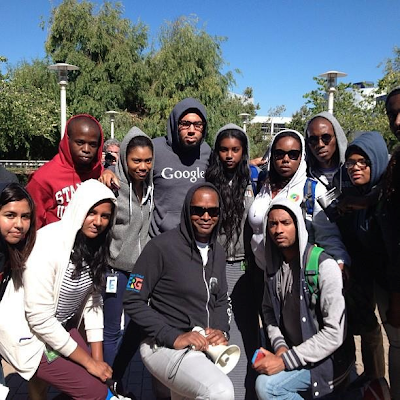
In response to the Trayvon Martin verdict, the Black Googler’s Network (BGN) organized a hoodie march on campus to raise awareness around unconscious bias and racial profiling. The march had a profound impact on me in showing the value of community and support among black Googlers. As Tanisha Hospedale, a senior at the University of Pennsylvania and People Operations intern, said, “I am very grateful for BGN and the family I have made from being a part of this group.”
One major takeaway from my internship is that Google continues to be a place where Googlers can bring their total selves to work while also having strong, supportive communities to fall back on. “I can tell that Google doesn't just talk about a commitment to diversity and inclusion, but actually demonstrates this through supporting ERGs,” said Jasmine McElroy, a senior at Howard University and People Operations intern. “These groups have made me feel like I belong here.”
Posted by Shawn Dye, People Operations BOLD intern and senior Stanford University
Labels
Africa
19
Android
58
April 1
4
Asia
39
Europe
46
Latin America
18
accessibility
41
acquisition
26
ads
131
apps
418
books + book search
48
commerce
12
computing history
7
crisis response
33
culture
12
developers
120
diversity
35
doodles
68
education and research
144
entrepreneurs at Google
14
faster web
16
free expression
61
google.org
73
googleplus
50
googlers and culture
202
green
102
maps and earth
194
mobile
124
online safety
19
open source
19
photos
39
policy and issues
139
politics
71
privacy
66
recruiting and hiring
32
scholarships
31
search
505
search quality
24
search trends
118
security
36
small business
31
user experience and usability
41
youtube and video
140
Archive
2016
Nov
Oct
Sep
Aug
Jul
Jun
May
Apr
Mar
Feb
Jan
2015
Dec
Nov
Oct
Sep
Aug
Jul
Jun
May
Apr
Mar
Feb
Jan
2014
Dec
Nov
Oct
Sep
Aug
Jul
Jun
May
Apr
Mar
Feb
Jan
2013
Dec
Nov
Oct
Sep
Aug
Jul
Jun
May
Apr
Mar
Feb
Jan
2012
Dec
Nov
Oct
Sep
Aug
Jul
Jun
May
Apr
Mar
Feb
Jan
2011
Dec
Nov
Oct
Sep
Aug
Jul
Jun
May
Apr
Mar
Feb
Jan
2010
Dec
Nov
Oct
Sep
Aug
Jul
Jun
May
Apr
Mar
Feb
Jan
2009
Dec
Nov
Oct
Sep
Aug
Jul
Jun
May
Apr
Mar
Feb
Jan
2008
Dec
Nov
Oct
Sep
Aug
Jul
Jun
May
Apr
Mar
Feb
Jan
2007
Dec
Nov
Oct
Sep
Aug
Jul
Jun
May
Apr
Mar
Feb
Jan
2006
Dec
Nov
Oct
Sep
Aug
Jul
Jun
May
Apr
Mar
Feb
Jan
2005
Dec
Nov
Oct
Sep
Aug
Jul
Jun
May
Apr
Mar
Feb
Jan
2004
Dec
Nov
Oct
Sep
Aug
Jul
Jun
May
Apr
Feed
Google
on
Follow @google
Follow
Give us feedback in our
Product Forums
.






 Follow

